Autoclave Sterilization Indicator Strips: Complete Guide
Autoclave sterilization indicator strips are mainly used to check whether the sterilization cycle inside an autoclave actually reached the required conditions.
In places like pharma labs, hospitals, and cleanroom facilities, even a small sterilization issue can create problems later — contamination, rejected material, or compliance-related concerns. Because of that, people usually don’t rely on the machine reading alone.
That’s where these strips come in. They’re placed inside the load to give a clearer idea of whether the required temperature and steam exposure were properly achieved during the cycle. It’s a simple check, but in critical environments, it becomes part of regular validation and monitoring.
In the sections below, we’ll go through how autoclave sterilization works, why these indicator strips are used, and a few important things that matter when choosing a sterilization system for consistent performance.
What is Autoclave Sterilization?
At a basic level, autoclave sterilisation is simple. Pressurised steam is used to destroy microorganisms.
But in practice, it’s not just about steam.
For the process to work reliably, three conditions need to stay aligned — temperature, pressure, and time. If even one of these shifts slightly, the outcome can change.
It may not seem like a big issue initially. But in controlled environments, even small variations matter more than expected.
That’s why autoclaving is still considered one of the most dependable methods — but only when it is controlled properly, not just assumed.
What Happens During the Autoclave Sterilisation Process
Once you see it in action, the process isn’t that hard.
The first step is to put things in the chamber, leaving enough space between them for steam to circulate around during the cycle. The system starts taking out air when the door is closed, before the steam pressure builds up within.
This portion is considerably more crucial in vacuum cycle autoclaves since the steam needs to spread uniformly across the whole load.
Once the chamber reaches the right temperature and pressure, such conditions are kept for a while so that sterilisation can happen correctly.
After then, the cycle goes through drying before the chamber is opened again.
Autoclave Sterilization Temperature, Time and Pressure
Standard values are well known.
Temperature usually falls between 121°C and 134°C.
Pressure stays around 15 to 30 PSI.
Cycle time ranges from 15 to 45 minutes.
On paper, this looks fully controlled.
But real conditions are different.
Load type, material density, placement inside the chamber — all of these influence the result. So even if the machine shows correct parameters, it doesn’t always confirm complete sterilisation.
That difference is easy to overlook.
Why Autoclave Sterilization Indicator Strips Are Important
Most setups rely heavily on machine readings.
That’s where the gap exists — and often, it’s larger than expected.
Machines show data.
Indicator strips reflect actual exposure.
When placed inside the load, they respond to real conditions and help confirm whether temperature, steam penetration, and time were actually achieved.
It’s a small step, but it removes uncertainty.
And interestingly, indicator strips are often treated as routine — until something goes wrong. Then suddenly, they become the most important checkpoint.
Types of Autoclave Sterilization Indicators
Not all indicators function the same way.
Chemical indicators provide a basic signal through colour change.
Biological indicators test whether microorganisms survive.
Integrators consider multiple parameters together.
In high-risk applications, relying on a single type is rarely enough. But that’s something most teams only realise after facing inconsistencies.
Steam Penetration and Validation in Autoclave Sterilization
In most pharma or hospital setups, people don’t depend on just one strip and call the process complete. Usually, sterilization gets checked in a few different ways, especially when the load is critical.
The Bowie Dick test is one of those checks. It’s mainly used to see whether air is being removed properly from the chamber. Because if air stays trapped inside, steam doesn’t spread evenly. And once that happens, sterilization can become unreliable in certain areas of the load.
This is why vacuum cycle autoclaves are monitored more carefully. Steam penetration matters a lot there.
You’ll also see different indicator classes being used depending on how closely the process needs to be checked.
- Class 4 indicators react to more than one parameter
- Class 5 indicators are closer to biological monitoring
- Class 6 indicators are made for specific cycles
In GMP environments, these checks are pretty normal. Many facilities also follow EN ISO sterilization standards to keep validation and documentation consistent over time.
Autoclave Specifications: What to Expect in Industrial Systems
Typical systems follow certain ranges:
| Parameter | Typical Range |
| Temperature | 121°C – 134°C |
| Pressure | 15 – 30 PSI |
| Chamber Material | SS 304 / SS 316 |
| Control System | PLC / Digital |
| Door Type | Single / Double |
| Capacity | 50L – 500L+ |
These are standard references. Actual configuration depends on the application.
Autoclave vs Other Sterilization Methods
In theory, multiple sterilisation methods exist. In practice, the difference becomes clear.
| Method | Practical Experience | Limitation |
| Autoclave | Consistent and reliable | Needs validation |
| Dry Heat | Limited usage | Slower |
| Chemical | Suitable for specific cases | Handling issues |
Most operators eventually come to the same conclusion — autoclave works best, but only when used correctly.
Why Double Door Autoclaves Are Used in Critical Environments
In controlled environments, sterilization alone is not enough.
Contamination control is equally critical.
Double door autoclaves help maintain separation between clean and non-clean areas. Materials move from one side to the other without cross exposure.
It may seem like a small design change. But in real conditions, it improves process reliability more than expected.
Autoclave Sterilization Cost: What Affects Pricing
Autoclave sterilization cost depends on system size, automation level, chamber design, and validation features.
And this is where expectations usually don’t match reality.
Cost depends on factors like chamber size, design type, automation level, material quality, and validation features.
Smaller lab units are more affordable.
Industrial systems, especially double-door autoclaves, require a higher investment.
But inconsistent sterilization often leads to higher long-term cost than the equipment itself. That part usually becomes clear later.
Why Choosing the Right Autoclave System Matters
In critical environments, the choice of autoclave matters more than it looks at first.
It’s not just about having a system that runs. Most systems do. The real difference shows up in how consistently they perform over time.
Things like chamber design, how evenly steam spreads, or whether proper validation support is there – these details don’t always stand out in the beginning. But they start to matter once the system is in regular use.
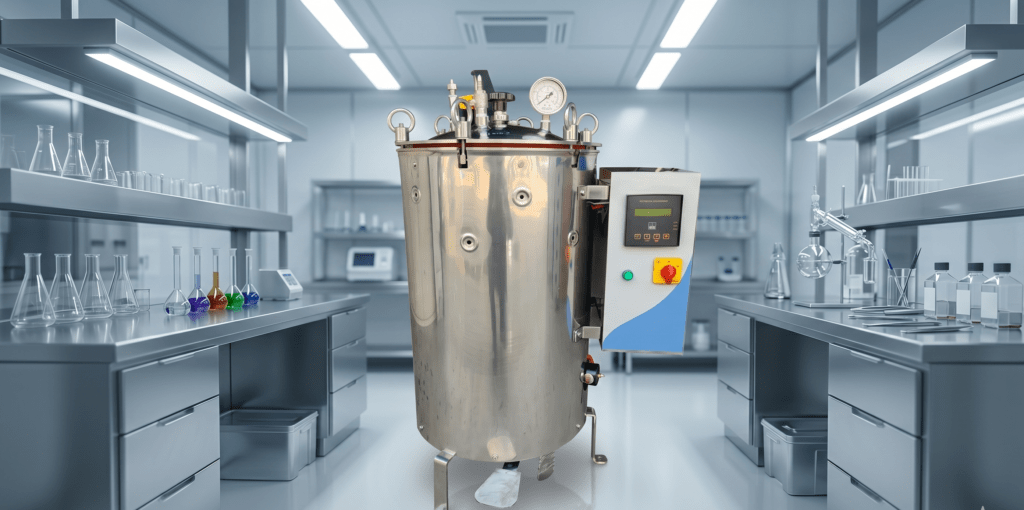
That’s one reason double door autoclaves are preferred in pharma and cleanroom setups. They’re built to handle both sterilization and contamination control without mixing the two.
At the end of the day, it’s less about the machine itself… and more about how reliably it does the job, again and again.
Common Sterilization Mistakes
Most failures are not due to machine faults.
They come from small oversights — overloading, incorrect cycle selection, ignoring validation, or poor maintenance.
Individually, they don’t seem serious.
But together, they create risk.
FAQs
What is autoclave sterilization?
It’s basically steam under pressure used to kill microorganisms. Labs use it all the time. The real part is… making sure it actually worked.
How do autoclave sterilization indicator strips work?
They react to conditions inside the chamber. If everything is right, the strip changes colour. That small change tells you a lot.
What is the usual autoclave sterilization temperature and time?
Usually around 121°C to 134°C. Time can be 15 minutes… sometimes more. Depends on what’s inside.
Why are autoclave sterilization indicators important?
Because the display can look fine… and still miss something. Indicators just double-check things.
What is the difference between autoclave and sterilizer?
An autoclave is one type of steriliser: the one that uses steam. Others use heat or chemicals.
What affects autoclave sterilization pressure and performance?
Small things, mostly. Load size, air inside, steam flow. Doesn’t look big… but it matters.
Conclusion
Sterilization itself is not complicated.
Consistency is.
Running a cycle is easy. Getting reliable results every time is not.
Indicator strips don’t complicate the process — they make it dependable.
Get the Right Sterilization Solution
If your current sterilization setup is just running cycles and hoping everything works it might be worth taking a closer look.
Sometimes the issue isn’t obvious. The system runs fine, the readings look normal, but consistency is where things start slipping.
That’s usually where the right setup makes a difference.
If you’re planning to upgrade or even just want clarity on what would work better for your application, it helps to talk it through first.
You can reach out, discuss your requirement, and see what kind of system actually fits — instead of guessing and fixing things later.