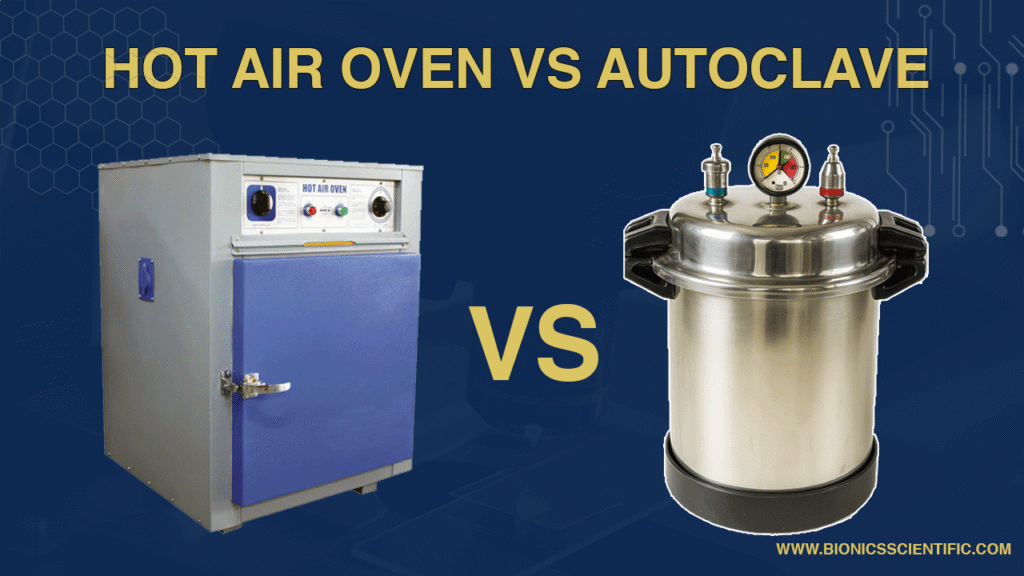
Hot Air Oven vs Autoclave is one of the most important comparisons in laboratory sterilisation. Choosing the right method directly impacts safety, efficiency, and material quality. While both are used to eliminate microorganisms, they operate on completely different principles—dry heat vs moist heat. Understanding their differences helps you select the right equipment for your application.
Quick Answer
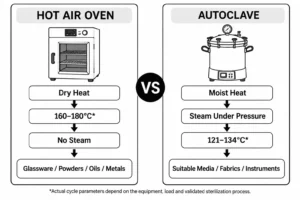
A hot air oven is an equipment that uses dry heat whereas the autoclave uses moist heat, which is steam under pressure. The hot air ovens are normally suitable for materials that can be exposed to dry heat such as glassware, powder, oils, and metal materials. Conversely, the autoclaves are normally suitable for materials such as culture media and fabric.
- What is a hot air oven?
- Working Principle of a Hot Air Oven:
- Hot Air Oven vs Autoclave: Comparison Table
- What is an autoclave?
- Working Principle of an Autoclave:
- Hot Air Oven vs Autoclave: Comparison Table
- Common Uses of Autoclaves:
- Which is better for dry sterilisation?
- Why Hot Air Ovens are Ideal for Dry Sterilisation:
- Key Differences Between Hot Air Oven and Autoclave
- Limitations of Both Methods
- Reasons for Bionics Scientific
What is a hot air oven?
A hot air oven is a dry-heat sterilization device that uses heated air to sterilize suitable heat-resistant materials without steam or moisture. Rather than forcing moisture through pressure, as autoclaves do, the heat-based sterilization surrounds the item with hot, circulated air that gradually and eventually warms its surfaces and internal cavities. This method capitalises on conduction, where the heat travels from the external layer of the load inward until the entire object reaches the required sterilising temperature.
A Hot Air Oven is a dry heat sterilization device widely used in laboratories and industries where moisture-free sterilisation is required.
Working Principle of a Hot Air Oven:
The chamber of typical lab sterilisation equipment is set to between 160°C and 180°C, with the exact value depending on the material being sterilised and the time available. Once the desired temperature has stabilised, the timer starts, and the load is held at that level for a specific duration, often ranging from one to several hours. Dry heat destroys microorganisms through prolonged exposure to elevated temperatures, making it suitable for selected heat-stable materials that should remain dry, all of which collectively renders the items free of viable microorganisms. Because no steam or chemical residue is involved, users frequently prefer this approach for metals, glassware, powders, and other heat-stable materials that must remain perfectly dry after processing.
Compared to autoclaves, this process takes longer but ensures complete dryness without any moisture damage.
Common Uses of Hot Air Ovens:
- Sterilizing glassware (Petri dishes, test tubes)
- Sterilizing metal equipment (forceps, scalpels)
- Sterilizing heat-resistant powders and oils
- Sterilizing heat-resistant containers
Hot Air Oven vs Autoclave: Comparison Table
|
Feature |
Hot Air Oven |
Autoclave |
|
Sterilization method |
Dry heat |
Moist heat / steam |
|
Typical temperature |
Commonly 160–180°C |
Commonly 121–134°C |
|
Pressure |
Atmospheric pressure |
Uses pressurized steam |
|
Typical cycle |
Longer |
Generally shorter |
|
Suitable materials |
Glass, metals, powders, oils |
Media, fabrics, suitable instruments |
|
Moisture |
No steam |
Steam present |
|
Main consideration |
Heat penetration takes longer |
Materials must tolerate moisture and pressure |
What is an autoclave?
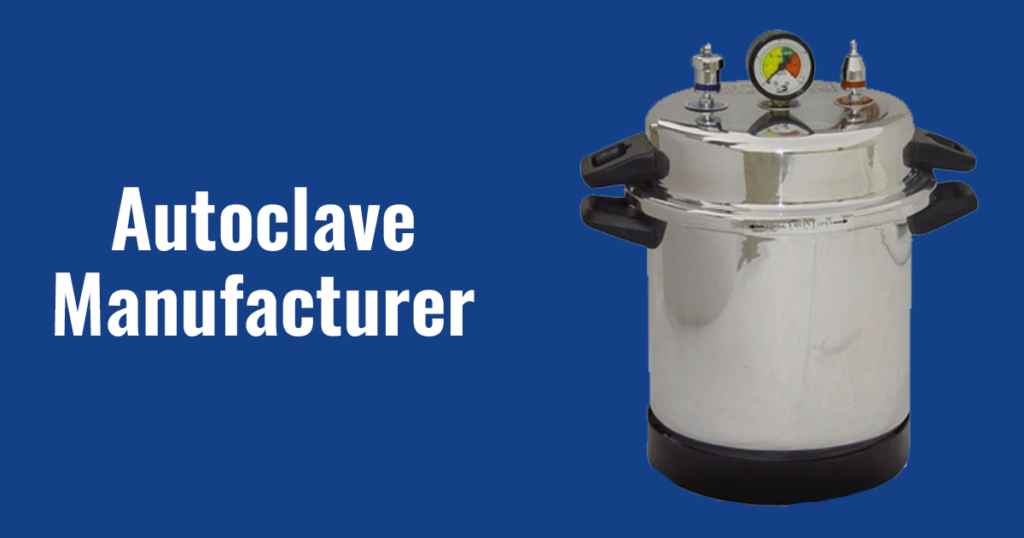
An autoclave steriliser, on the other hand, employs moist heat (steam) at high pressure to sterilise materials. It typically operates at temperatures around 121°C and a pressure of 15 PSI to 30 PSI for a period of 15 to 30 minutes, depending on the type of material being sterilised.
Working Principle of an Autoclave:
Autoclave machines utilise steam to penetrate materials, with the high pressure and heat working together to denature the proteins in microbes, making them inactive. This method is particularly effective against a wide range of pathogens, including bacteria, viruses, and even spores.
Hot Air Oven vs Autoclave: Comparison Table
Common Uses of Autoclaves:
- Sterilizing medical tools (surgical instruments, syringes)
- Sterilizing lab media (culture plates, broths)
- Sterilizing rubber and cloth items
- Sterilizing contaminated lab waste
Which is better for dry sterilisation?
When it comes to dry sterilisation, the hot air oven is the preferred choice.
If your application requires completely dry sterilisation without any risk of corrosion or moisture damage, a hot air oven is the suitable choice.
Why Hot Air Ovens are Ideal for Dry Sterilisation:
- Specifically designed for dry sterilisation: Hot air ovens are built to sterilise without the need for moisture, making them perfect for dry materials.
- No risk of water damage: Since they don’t use steam, there’s no risk of damaging moisture-sensitive items.
- Safer and easier to operate: With no high-pressure components, hot air ovens are safer to use and require less maintenance.
- Perfect for dry materials: Glassware, oils, powders, and metal objects are ideal candidates for hot air sterilisation.
However, if you need a faster sterilisation process or need to sterilise moist items, an autoclave is the better choice.
Which One Should You Choose?
| If you need to sterilizer | Choose |
|---|---|
| Glassware | Hot Air Oven |
| Powders | Hot Air Oven |
| Oils | Hot Air Oven |
| Suitable metal items | Hot Air Oven |
| Culture media | Autoclave |
| Suitable fabrics | Autoclave |
| Moist materials | Autoclave |
| Suitable laboratory waste | Autoclave |
The final choice should always depend on the material, validated sterilization method, load configuration and equipment specifications.
Key Differences Between Hot Air Oven and Autoclave
Hot Air Oven:
- Best for dry materials (glassware, metal, powders)
- Takes longer (generally 1.5 to 2 hours at 160°C)
- Doesn’t use moisture, so no risk of water damage
- Safer and simpler: No pressure parts
Autoclave:
- Best for moist items (surgical instruments, lab coats, culture media)
- Faster sterilization time (15 to 30 minutes)
- Uses steam under pressure, which is more powerful at killing a wider range of microbes, including spores
- Requires regular maintenance and handling precautions due to steam pressure
Where to Use Hot Air Ovens and Autoclaves
Hot air ovens are ideal for:
- Microbiology Labs: Sterilizing glassware, Petri dishes, and pipettes
- Pharmaceutical Industry: Sterilizing ointment containers, powders, and vials
- Cosmetics: Sterilizing oils, creams, and bottles
- Autoclaves are best for:
- Hospitals: Sterilizing surgical instruments, bandages, and syringes
- Research Labs: Sterilizing culture media, lab coats, and contaminated materials
- Waste Disposal: Sterilizing infected waste or contaminated tools.
|
Application |
Hot Air Oven |
Autoclave |
|
Glassware |
✓ |
— |
|
Powders |
✓ |
— |
|
Oils |
✓ |
— |
|
Culture media |
— |
✓ |
|
Suitable fabrics |
— |
✓ |
|
Suitable surgical instruments |
— |
✓ |
|
Moist materials |
— |
✓ |
Limitations of Both Methods
Limitations of Hot Air Ovens:
- Cannot sterilize moist or cloth items
- Longer sterilization time
- Not as effective against certain resistant spores compared to autoclaves
Limitations of Autoclaves:
- Cannot sterilize powders or oils due to moisture sensitivity
- Requires regular servicing and maintenance
- Risk of steam burns if mishandled
Final Verdict: Hot Air Oven vs Autoclave
Hot Air Oven and Autoclave both serve critical roles in sterilization, but the right choice depends on your application. If your priority is dry sterilization without moisture damage, a hot air oven is the best investment. However, if speed and deep penetration sterilization are required, an autoclave is the better option.
Get the Right Sterilization Equipment for Your Lab
Choosing the wrong sterilization method can cost time, money, and safety. At Bionics Scientific, we provide high-performance hot air ovens and autoclaves designed for accuracy, durability, and compliance.
Request a quote today and get expert guidance to select the perfect equipment for your application.
Reasons for Bionics Scientific
Bionics Scientific has been producing laboratory & medical equipment for the last 35 years, and vertical & horizontal autoclaves, laboratory refrigerators, mortuary equipment have been delivered all over India and overseas countries like the USA, UK, UAE, Saudi Arabia, South Africa, Canada, Australia, Singapore, Malaysia, Philippines, Indonesia, Kenya, Nigeria, Bangladesh, Nepal, Qatar, Oman, Kuwait, Bahrain, Vietnam, Thailand, Tanzania, Ghana, Sri Lanka, and New Zealand.
The manufacturing process is certified by Euroglobe Registrars (UK), an independent internationally operating certification body set up in 2007:
Certifications & Quality Compliance
|
Standard |
Cert. No. |
Scope |
Valid Until |
|
ISO 9001:2015 (QMS) |
184876 |
Lab, scientific & cleanroom equipment mfg. |
30-03-2029 |
|
CE (MDD 93/42/EEC) |
184877 |
Products as per annexure |
30-03-2029 |
|
GMP |
184878 |
Includes fume hood and a biosafety cabinet. |
30-03-2029 |
|
NSF/ANSI 61 |
183884 |
Bio-safety cabinet, lab & scientific equipment |
08-03-2027 |
Frequently Asked Question
What is the difference between a hot air oven and an autoclave?
Hot air ovens use dry heat while autoclaves use moist heat (pressure steam).
Which is better to sterilize glassware?
Hot air ovens are better to sterilize heat resistant glassware because it can sterilize without moisture.
Which process is faster, hot air oven or autoclave?
Autoclaves are faster compared to hot air sterilization since the latter takes longer times.
Which device can be used to sterilize powders and oils?
Powders and oils cannot be sterilized using autoclaving because they cannot be subjected to moist heat.
Which device can be used to sterilize culture media?
Culture media cannot be sterilized using hot air ovens because they require moist heat; otherwise, hot air ovens will interfere with the material.
Does the hot air oven need steam?
No. Hot air ovens work under normal pressures using hot air.
Is steam required for the autoclave?
Yes. It requires steam under pressure to achieve the required parameters for sterilization.
Which one should I use for my laboratory?
It depends on the type of material, wetting, cycle, load, and method of sterilization validated. Hot air ovens can be used to sterilize dry and heat resistant material, whereas the autoclave is more universal.
Is there any common thing about both?
Yes. Both can provide sterilization when the proper cycle and operating parameters are chosen for the specific load.
Is the hot air oven safer than the autoclave?
Hot air oven does not contain pressurized steam, whereas the autoclave works under heat and pressure.