A commercial deep freezer usually gets attention only after a storage problem creates trouble inside a lab or production facility.
Sometimes a freezer stops maintaining temperature during night operation. Sometimes samples near the front section begin showing instability after repeated door opening. In pharmaceutical environments, even a small fluctuation can create serious concern because nobody wants to risk expensive material after months of work.
That is where buyers start thinking differently.
The discussion slowly moves away from storage capacity and starts focusing on refrigeration stability, insulation performance, compressor durability, and temperature recovery speed. A freezer may look fine from outside, but laboratories care more about what happens after continuous operation for several years.
Research facilities deal with biological samples that cannot be recreated easily. Hospitals store plasma, vaccines, and diagnostic materials that require controlled low-temperature conditions every hour of the day. Industrial storage plants face another challenge altogether. Their systems operate continuously under heavy loading conditions, often without shutdown.
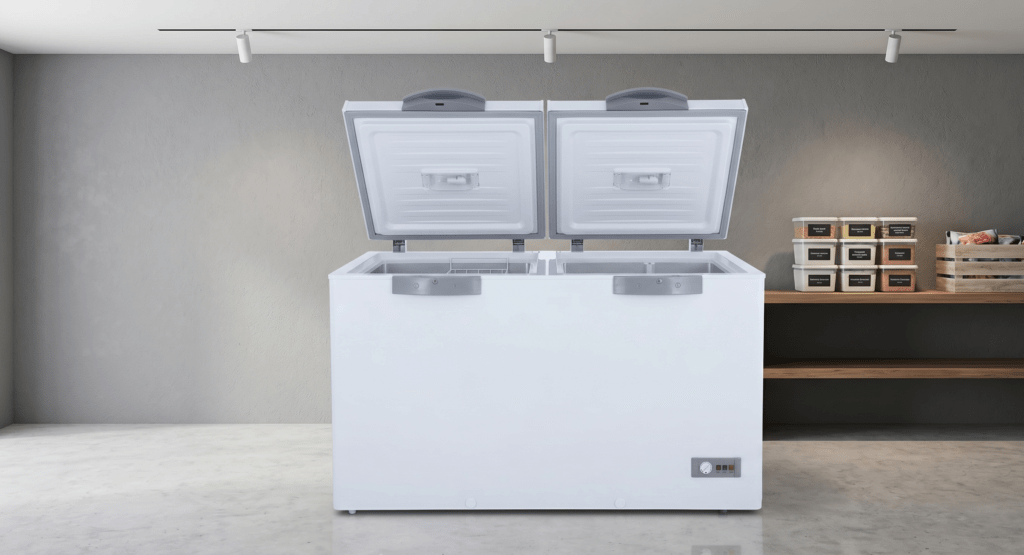
Bionicsscientific manufactures commercial deep freezer systems for pharmaceutical labs, hospitals, biomedical storage facilities, research centers, and industrial applications where refrigeration stability becomes part of everyday operations.
Why Commercial Deep Freezers Are Used in Laboratories and Industry
Industrial storage conditions are rough compared to normal commercial usage.
Inside a laboratory, freezer doors may open dozens of times during working hours. Sample trays move constantly. Internal load changes throughout the day. In many facilities, the equipment runs non-stop for years.
Regular domestic systems are not designed for that kind of pressure.
A laboratory deep freezer is commonly used for reagents, enzymes, microbiology cultures, pharmaceutical compounds, biological samples, and research materials that need stable freezing conditions for long periods. Some research samples remain stored for months before they are used again. Losing them means repeating the entire process from the beginning.
That becomes expensive very quickly.
Hospitals and diagnostic centers rely heavily on biomedical freezer systems because unstable storage can affect blood products, plasma, and patient-related samples. Vaccine storage freezer systems require even tighter control because vaccines react badly to temperature fluctuation.
Some facilities also use biomedical freezer systems for sensitive sample preservation and long-duration laboratory storage.
Food processing facilities also use industrial deep freezer systems regularly, especially during long-duration inventory storage. Chemical industries have similar requirements for temperature-sensitive compounds that become unstable under changing conditions.
Most experienced buyers stop focusing only on deep freezer price after facing repeated maintenance issues with low-cost refrigeration systems.
Why Temperature Instability Creates Storage Problems
Many storage failures start quietly.
The freezer display may continue showing the correct temperature while actual internal conditions begin shifting slowly during heavy operation. Laboratories often notice the problem near door sections first because those areas experience higher fluctuation after repeated opening cycles.
This usually happens in overloaded or poorly insulated systems.
Weak insulation allows outside heat to affect internal conditions throughout the day. The compressor then runs harder to maintain cooling. Recovery becomes slower. Energy usage increases. Eventually the refrigeration system remains under constant stress.
Summer conditions make the problem worse in facilities where room temperatures already remain high.
Some pharmaceutical labs learned this after discovering sample instability even though the controller display appeared normal during routine checking. The issue was not temperature generation. It was temperature consistency inside the chamber.
That difference matters a lot in biomedical storage.
Compressor Quality Changes Everything Later
Most buyers look at compressors only briefly during initial discussions. After a few years of operation, that usually changes.
A weak refrigeration system may work normally in the beginning. Problems appear later under continuous industrial workload. Cooling recovery slows down. Noise increases. Temperature stabilization takes longer after door opening.
Then maintenance calls start becoming frequent.
A heavy duty deep freezer used inside pharmaceutical facilities or industrial storage environments needs refrigeration systems capable of handling uninterrupted operation for long durations. Smaller compressors struggle under those conditions.
Many procurement teams move toward industrial-grade or imported compressor systems after earlier experiences with unstable cooling performance. Not because of branding alone. Mostly because continuous operation exposes weaknesses quickly.
For laboratories storing biological material, refrigeration failure becomes more than a maintenance issue. Sometimes years of research depend on stable storage conditions.
That changes purchasing decisions immediately.
Why Insulation Quality Matters More Than Buyers Expect
Insulation rarely gets attention during the first discussion, but poor insulation creates long-term operational problems faster than many people expect.
Thin insulation continuously increases heat transfer. The compressor compensates for it by operating harder throughout the day.
Energy consumption shows an upward trend. The recovery of temperature takes longer after each opening of the doors.
The laboratories that have easy access to it will notice the trend before anyone else.
An effectively insulated stainless steel deep freezer should prove superior in terms of its efficiency because of higher heat retention.
Some facilities specifically ask about insulation thickness before discussing cabinet design now. A few years ago, buyers mostly ignored it.
Operational experience changes priorities.
Digital Monitoring Makes Daily Operation Easier
Older manual thermostat systems still exist, but pharmaceutical and biomedical storage environments increasingly prefer digital temperature freezer systems for one simple reason.
Visibility.
Laboratories want to see what is happening inside the storage chamber without guessing. Digital controllers allow more accurate monitoring throughout operation. Alarm systems help identify unusual variation early before samples become affected.
Power failure alerts are especially important.
Several laboratories started upgrading storage monitoring only after overnight electrical interruptions damaged stored material without anyone noticing immediately. Backup alarm systems now play a much bigger role in pharmaceutical storage than before.
Vaccine storage applications depend heavily on this type of monitoring because temperature-sensitive products can lose stability much faster than expected during uncontrolled fluctuation.
For vaccine storage practices, many laboratories also follow WHO cold chain storage recommendations.
Why Commercial Deep Freezer Systems Are Used in Laboratories
Commercial deep freezer specifications usually vary according to storage application and operational workload.
Most pharmaceutical and laboratory systems operate across controlled temperature ranges suitable for biological samples, research compounds, vaccines, chemicals, and industrial storage materials. Storage capacity may range from compact laboratory cabinets to large industrial cold storage freezer systems.
Vertical deep freezer models are commonly preferred in laboratories because organized sample access becomes easier in limited floor space. Cooling systems generally use direct cooling or forced-air refrigeration depending on application requirements.
Digital microprocessor controllers are widely used for accurate temperature monitoring and adjustment. Stainless steel internal chambers improve hygiene maintenance and corrosion resistance, particularly inside biomedical and pharmaceutical environments.
Industrial systems usually include alarm support for high temperature, low temperature, door opening, and power interruption conditions. Adjustable shelving helps laboratories organize storage more efficiently.
Commercial Deep Freezer vs Standard Freezer
A standard freezer and a commercial freezer may appear similar from outside, but their behavior changes completely under continuous workload.
Standard systems are built mainly for light commercial or domestic usage. They are not designed for repeated industrial access cycles or sensitive pharmaceutical storage conditions.
The difference becomes obvious after long operation.
Commercial deep freezer systems recover cooling faster after door opening. Insulation performance remains stronger. Compressors handle continuous refrigeration load more effectively. Internal conditions remain more stable during heavy usage.
Standard freezers often struggle under those same conditions because refrigeration systems are not designed for sustained industrial operation.
Facilities storing vaccines, biomedical material, or pharmaceutical compounds usually avoid domestic-style systems once they experience the difference directly.
Commercial Deep Freezer vs Ultra Low Temperature Freezer
Some buyers assume ultra-low systems are automatically better. That is not always true.
An ultra low temperature freezer is mainly used for specialized biotechnology, genetic research, advanced pharmaceutical development, and highly sensitive biological preservation requiring extremely low storage temperatures.
Those systems consume more power, involve more complex refrigeration stages, and require heavier maintenance support.
A commercial deep freezer is sufficient for many laboratory, pharmaceutical, food processing, biomedical, and industrial storage applications where ultra-low conditions are unnecessary.
Most experienced procurement teams evaluate actual storage requirements carefully before increasing operational cost with ultra-low systems.
Commercial Deep Freezer Price Factors in India
Commercial deep freezer price in India depends on refrigeration design, insulation quality, cabinet construction, and storage performance.
In the case where there is low temperature, the cost of the equipment will be higher due to better cooling and insulating features. Quality of the compressor can also affect the cost of the refrigerator.
Although installing refrigeration systems in industry would be more costly, they would eventually be more dependable in terms of breakdown and repairs.
Costliness of the stainless steel freezers can be attributed to increased durability of the freezer cabinet.
Costliness of the equipment depends on various factors including controls, capacity, and controllers.
Most facilities eventually realize unstable refrigeration becomes more expensive over time than reliable equipment with slightly higher upfront cost.
Why Buyers Prefer an Experienced Deep Freezer Manufacturer in India
Industrial buyers usually stay with manufacturers who understand actual operational problems instead of repeating specification sheets during every discussion.
That matters during installation and even more during long-term operation.
A deep freezer manufacturer in india supplying pharmaceutical and laboratory systems must understand refrigeration stability, biomedical sensitivity, insulation performance, and continuous industrial workload conditions properly.
Bionicsscientific manufactures commercial deep freezer systems for hospitals, laboratories, pharmaceutical production units, research facilities, and industrial storage applications where reliable refrigeration performance matters continuously.
Most experienced procurement teams care far more about long-term support and stable operation than marketing language.
Because once stored material gets damaged, product brochures stop helping.
FAQs
What temperature range is commonly used in a commercial deep freezer?
The required range depends entirely on the storage material. Pharmaceutical products, vaccines, laboratory samples, and industrial compounds all require different storage conditions.
Why are vertical deep freezer systems common in laboratories?
Vertical deep freezer models help laboratories organize samples more efficiently while saving floor space.
Does insulation thickness affect freezer efficiency?
Yes. Better insulation improves temperature stability, reduces compressor workload, and supports faster recovery after repeated door opening.
Why do pharmaceutical labs prefer digital temperature freezer systems?
Digital monitoring improves visibility, helps detect fluctuation early, and supports safer storage conditions for sensitive material.
What affects commercial deep freezer price the most?
Compressor quality, insulation performance, temperature range, cabinet material, monitoring systems, and storage capacity affect pricing significantly.
How long can an industrial deep freezer last?
Operational life depends on refrigeration quality, workload conditions, maintenance practices, and insulation performance over time.
Contact Bionicsscientific for Commercial Deep Freezer Solutions
Most laboratories and pharmaceutical facilities start looking seriously at freezer quality only after facing storage instability or cooling problems.
Bionicsscientific provides commercial deep freezer systems used in research labs, hospitals, biomedical storage areas, and industrial facilities where steady cooling matters during daily work.
If you are planning to replace an older freezer, expand storage space, or discuss a new requirement, the team at Bionicsscientific can help you find a setup suitable for your application and storage conditions.