A mechanical sieve shaker Particle size testing is often viewed as a normal laboratory operation. However, when the same material consistently yields different findings, the underlying problem reveals itself. The problem sometimes lies not in the material itself, but in the method of screening. In manual sieving, hand movement, pressure, time and handling might influence the ultimate output. That is why mechanical sieve shakers are frequently used by laboratories that do regular testing.
Mechanical sieve shaker is used to separate materials by controlled vibration using varied mesh size of sieves. This results in more consistent particle size examination of powders, granules, soil, cement, minerals, chemicals and food items. This equipment also helps to save time and lowers manual work in laboratories where testing is done on a daily basis.
Bionics Scientific Technologies Pvt. Ltd. provides reliable sieve shaker equipment for laboratory and industrial testing applications. The company not only deals with delivering equipment, but also advises buyers on their choice of the best model in accordance with their real needs for testing.
What is a Mechanical Sieve Shaker?
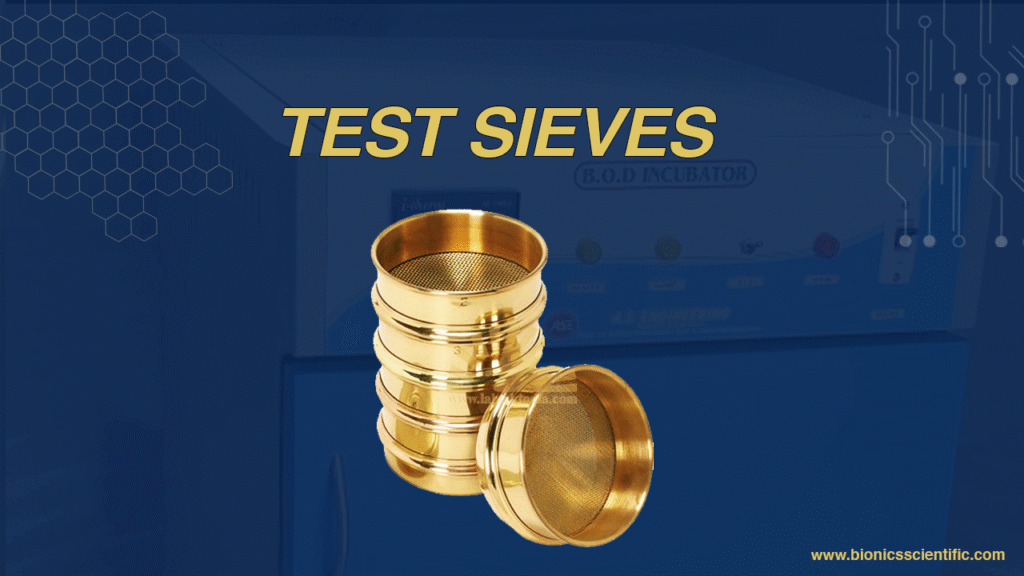
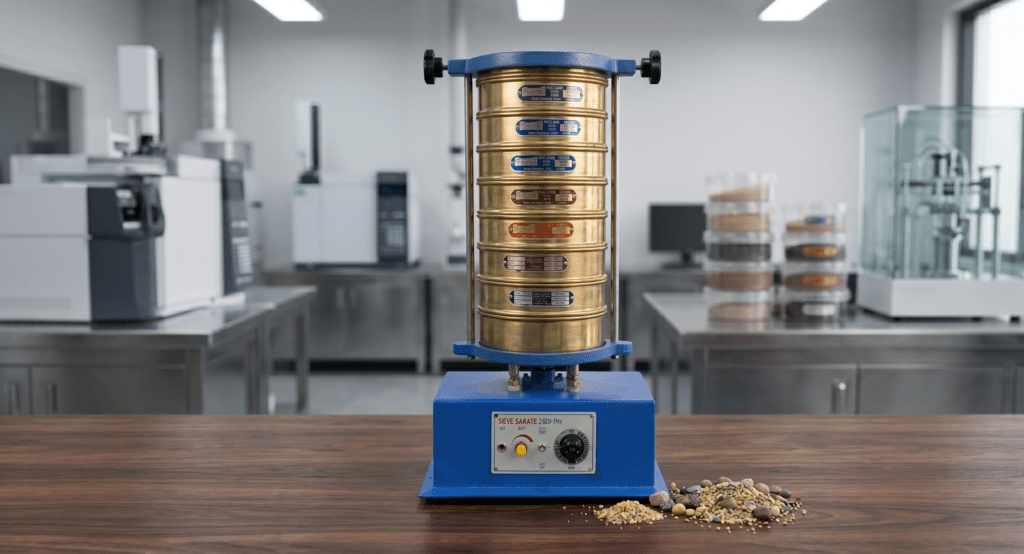
A mechanical sieve shaker is a laboratory equipment used to separate materials according to particle size with the help of stacked testing sieves. The sample is placed on the top sieve, and through vibration movement, smaller particles gradually pass through the lower mesh openings. Particles that cannot pass through the mesh remain retained on a particular sieve level.
In manual sieving, the results often depend on the operator’s experience, but in a laboratory sieve shaker machine, the movement remains more uniform and controlled. Because of this, result variation is reduced during repeated testing. It is widely used in pharmaceutical, soil testing, cement, construction, and research laboratories where consistent particle analysis is important.
Sieve Shaker Principle, Construction and Working
The functioning principle of a sieve shaker is pretty basic. The material is under constant vibration movement which makes the particles to migrate over the mesh surface. The lower sieves allow the smaller particles to pass through and the larger particles stay on the upper sieves. Separation technique is used to calculate particle size distribution.
A mechanical sieve shaker is normally made up of a motor, vibration mechanism, sieve retaining plate, clamping system, timer control and a sturdy base frame. The machine can be constructed with mild steel or stainless steel construction, depending on the application. Stainless steel models are normally used in pharmaceutical and chemical industries since they are easier to clean and more corrosion resistant.
In use, the operator places the sample on the top sieve and clamps the sieve
Most laboratories follow ASTM testing standards during sieve analysis for better accuracy and consistency.
Mechanical Sieve Shaker Uses
Mechanical sieve shakers are utilized in many different sectors that regularly conduct material testing. In pharmaceutical firms they are used to separate and verify powder particles before tablet and capsule manufacture. They are used in soil testing labs to determine the particle size and grading of soil.
Sieve shaker machines are used in construction and civil engineering labs for testing aggregate. These machines are used in cement companies to examine quality of raw material as well as final products. They are also used in food processing units to verify texture and consistency of flour, spices, grains and powdered ingredients.
The machines are also widely employed in chemical industries, mining sectors, research centers and colleges or laboratory institutes where particle size assessment is part of everyday work. When the same test has to be
Mechanical Sieve Shaker Price
Prices for a mechanical sieve shaker might range widely, as the testing needs of each consumer are distinct. Cost is mostly related to capacity of the machine, size of the sieve, number of sieves, quality of motor, timer system, body material, and vibration performance.
Smaller models for laboratories at a lesser price are commonly available and are often utilized for routine testing of samples. Industrial variants are more expensive, as they are designed for continuous usage, with larger samples, improved vibration stability, and heavy-duty operation.
When selecting a sieve shaker, price should never be the only factor. Testing errors and frequent maintenance difficulties can occur after regular use if the machine is poorly built or has unstable vibrations. A sturdy machine that runs smoothly and reliably and is adequate for the intended application is always a better buy.
Laboratory Sieve Shaker Machine vs Industrial Sieve Shaker Machine
| Feature | Laboratory Sieve Shaker Machine | Industrial Sieve Shaker Machine |
| Usage | Routine lab testing | Heavy material screening |
| Capacity | Small to medium samples | Large sample quantity |
| Structure | Compact body | Heavy-duty frame |
| Operation | Short testing cycles | Longer operation |
| Motor | Standard motor | Industrial motor |
| Suitable For | QC labs, research labs | Cement, mining, construction |
Technical Performance Details
In daily laboratory work, stable vibration makes a noticeable difference during particle testing. If the movement is uneven, the material does not spread properly across the sieve mesh, and that can affect the final reading. Because of this, laboratories usually pay attention to operating stability before selecting a Mechanical sieve shaker.
But, the sieves used in standard sieve testing machines rotate at a fixed speed of 280-300 rpm. This speed is chosen based on the principle that it can stir the sample without causing any scattering effect. In the case of sieve analysis, the amplitude of vibration is kept between 1.5 – 3 mm.
Compatibility with the sieve test according to American Society for Testing and Materials/Indian Standard is considered an important aspect in many laboratories since the mesh sizes of sieves used are standardized, making sure that the test results of different samples are replicable.
Noise level during operation usually remains within a comfortable laboratory range of about 55 dB to 70 dB. Power consumption depends on motor size and working load, but most laboratory models are designed for regular testing work without high electricity usage.
Mechanical Sieve Shaker Specifications
| Model | Capacity | Number of Sieves | Motor Power | Timer Range | Construction Material | Application Area |
| BSS-MS-01 | 2 Kg | 6 Sieves | 0.25 HP | 0–60 Min | Mild Steel | Soil Testing |
| BSS-MS-02 | 5 Kg | 8 Sieves | 0.5 HP | 0–99 Min | Stainless Steel | Pharmaceutical Lab |
| BSS-MS-03 | 10 Kg | 10 Sieves | 1 HP | Digital Timer | SS-304 | Cement & Mining |
| BSS-MS-04 | 15 Kg | 12 Sieves | 1.5 HP | Programmable | Heavy Duty SS | Industrial Screening |
Manual Sieve Shaker vs Mechanical Sieve Shaker vs Industrial Vibratory Sieve Shaker
| Feature | Manual Sieve Shaker | Mechanical Sieve Shaker | Industrial Vibratory Sieve Shaker |
| Operation | Hand operated | Motor driven | Vibratory motion |
| Accuracy | Depends on operator | More consistent | High |
| Effort | High | Low | Very low |
| Speed | Slow | Faster | Continuous |
| Use | Basic lab work | QC and testing labs | Industrial use |
| Result | Can vary | Repeatable | Highly stable |
Why Choose Bionics Scientific
Bionics Scientific Technologies Pvt. Ltd. has more than 25 years of experience in laboratory equipment manufacturing. The company works with laboratories, research centers, educational institutes, pharmaceutical companies, and industrial testing facilities.
Being an ISO-certified company, Bionics Scientific focuses on proper construction, stable vibration, quality checking and practical usability. We also provide customized laboratory solutions when buyers need specific sieve size, capacity, material construction or application-based changes.
Every Mechanical sieve shaker is checked before dispatch so the buyer gets equipment suitable for real laboratory use. After-sales support and technical guidance are also available, which is important when the equipment is used regularly.
How Bionics Scientific is Different from Other Mechanical Sieve Shaker Manufacturers
Many Mechanical sieve shaker manufacturers provide standard models, but every buyer does not have the same testing requirement. A soil testing lab, pharmaceutical lab and cement testing facility cannot always use the same configuration.
Bionics Scientific understands application differences before suggesting the model. We focus on vibration stability, strong body construction, proper sieve holding, simple operation and long-term use. Unlike only providing the details of our catalog, we help the customer choose a model depending on the number of samples as well as the reason for testing.
It’s only natural because this way, the client buys an item he finds useful rather than just another vibratory table.
Frequently Asked Questions
What is a Mechanical sieve shaker used for?
A Mechanical sieve shaker is used for particle size analysis and material separation through controlled vibration.
Which industries use sieve shaker machines?
Pharmaceuticals, cement, construction, food, chemicals, mining, soil testing labs and research laboratories use sieve shaker machines.
What affects Mechanical sieve shaker price?
Capacity, motor power, sieve holding size, timer type, construction material and customization affect the price.
Any customized models can be supplied from Bionics Scientific?
Customized models are available depending on sieve size, capacity, and usage.
How does the laboratory model differ from the industrial one?
Laboratory model is employed for routine testing while industrial one is for mass production.
Request Mechanical Sieve Shaker Price and Details
If you are planning to buy a Mechanical sieve shaker for your laboratory or testing facility, Bionics Scientific Technologies Pvt. Ltd. can help you choose the right model according to your sample type, sieve size, and testing requirement.
Contact our team for Mechanical sieve shaker price, specifications, and customized laboratory solutions with 24-hour support assistance.